landmarks.im
The Pyramids of Giza
Three 4th-dynasty royal tombs on the west bank of the Nile. The Great Pyramid of Khufu is the only surviving wonder of the ancient world. This site stays with what good sources say, and with the figures they still cannot quite agree on.
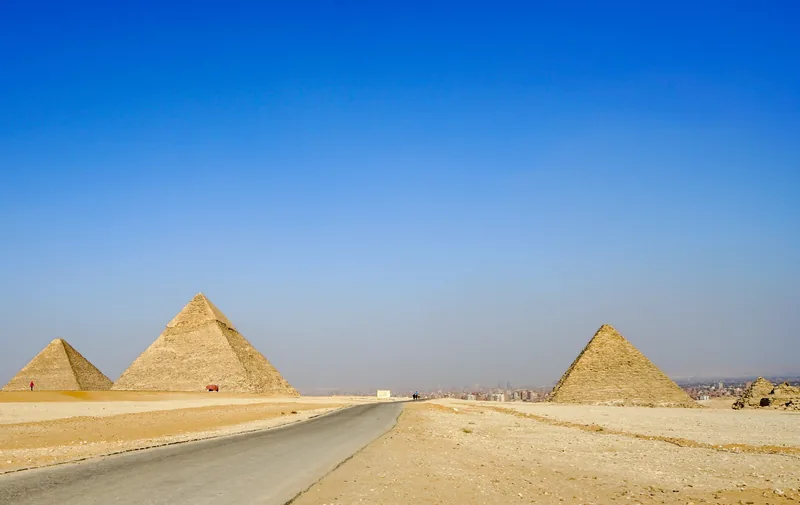
The plateau desk
Choose one of the three main pyramids to see the figures Encyclopaedia Britannica publishes for it. The same figures stay in the table below, including the places where two Britannica articles disagree. This is a desk, not a game: there is no score and no timer.
The marks are only a sketch of relative size, not a map of the plateau.
Choose a pyramid
The table is the full set of figures. Use the marks above to bring one pyramid forward, or read the table as it stands.
The table scrolls sideways on a small screen.
Usual figures from Encyclopaedia Britannica, with disagreements kept in view
| Pyramid | Who it was built for | Place in the group | Base (each side) | Original height | Height now |
|---|---|---|---|---|---|
| Khufu (Cheops) | Second king of the 4th dynasty | Northernmost and oldest; the Great Pyramid | 755.75 ft (230 m) average | 481.4 ft (147 m); or about 482 ft (147 m) in the Great Pyramid article | 451.4 ft (138 m) in the Giza article; 449 ft (137 m) in the Great Pyramid article |
| Khafre (Chephren) | Fourth of the eight 4th-dynasty kings | The middle pyramid | 707.75 ft (216 m) | 471 ft (143 m) | Not separately stated. Retains outer casing only at the top. |
| Menkaure (Mykerinus) | Fifth king of the 4th dynasty | Southernmost and last | 356.5 ft (109 m) | Completed height 218 ft (66 m) | Not separately stated. The casing, as with the others, has been stripped. |
Figures follow Britannica’s Pyramids of Giza article, checked 15 November 2026. The two current-height figures for Khufu, and the two original-height wordings, are both from Britannica. A 1984–85 survey published by Glen Dash in AERAGRAM 13.2 gives a mean casing length of 230.329 m for Khufu, which agrees with Britannica at the metre.
UNESCO describes the Great Pyramid of Khufu as the only surviving wonder of the ancient world.1 UNESCO’s official short description notes that in ancient times the site was considered one of the Seven Wonders of the World.2 Encyclopaedia Britannica’s Pyramids of Giza article dates the three pyramids to the 4th dynasty, c. 2575–c. 2465 BCE, on a rocky plateau on the west bank of the Nile near Al-Jīzah (Giza).3
The northernmost and oldest pyramid of the group was built for Khufu (Greek: Cheops), the second king of the 4th dynasty, and is called the Great Pyramid.3 The middle pyramid was built for Khafre (Greek: Chephren), the fourth of the eight kings of the 4th dynasty.3 The southernmost and last pyramid to be built was that of Menkaure (Greek: Mykerinus), the fifth king of the 4th dynasty.3
These are funerary monuments, not a puzzle box. Alternative claims belong on the myths page, where they are checked rather than crowned.
The three pyramids
Khufu, Khafre and Menkaure, side by side, with the figures that still disagree.
Inside the Great Pyramid
A labelled section and a chamber-by-chamber walk along the published route.
The Great Sphinx
A limestone figure with a man’s face and a lion’s body, near Khafre’s valley temple.
How they were built
The question has not received a wholly satisfactory answer. The plausible account, and the workforce disagreement, stay in view.
Printables and books
A reference guide, an activity pack, a companion to the three kings, and a bundle, plus archaeology and site guides.
Games
A quiz and a myth-or-fact board that test published facts, including the ones that disagree.