The plateau
Khufu, Khafre and Menkaure
Three kings of the 4th dynasty, three pyramids on one rocky plateau, and a wider necropolis that UNESCO counts as more than thirty-eight pyramids.
Encyclopaedia Britannica’s Pyramids of Giza article dates the three pyramids to the 4th dynasty, c. 2575–c. 2465 BCE, on a rocky plateau on the west bank of the Nile near Al-Jīzah (Giza).1 The necropolis, UNESCO says, includes the three pyramids of Giza and the Great Sphinx, among more than thirty-eight pyramids.2 Memphis, UNESCO records, is traditionally believed to have been founded in 3000 BC as the capital of a politically unified Egypt.2
The first pyramid ever built, in UNESCO’s wording, is the Pyramid of Djoser, or the Step Pyramid, at Saqqara — not at Giza.2
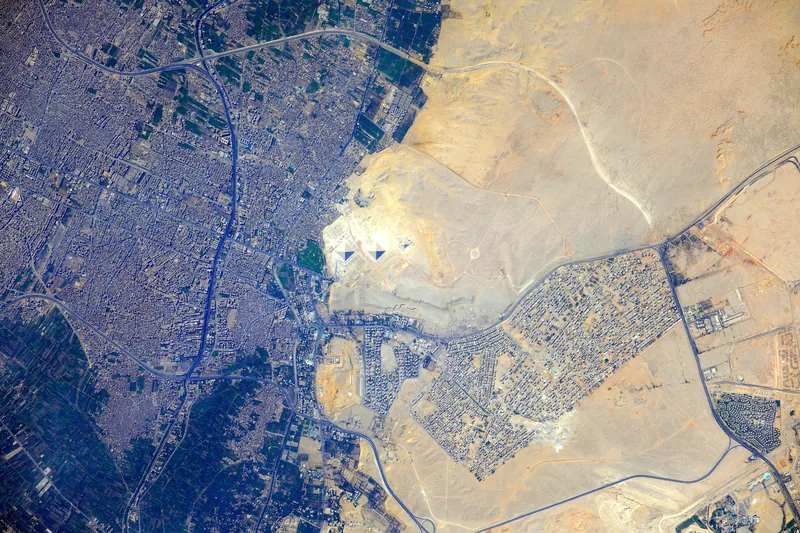
The northernmost and oldest pyramid of the group was built for Khufu (Greek: Cheops), the second king of the 4th dynasty, and is called the Great Pyramid.1 Britannica gives the Great Pyramid a base averaging 755.75 feet (230 metres) on each side and an original height of 481.4 feet (147 metres).1 The same article says the Great Pyramid is now only 451.4 feet (138 metres) high, after being almost entirely stripped of its outer casing of smooth white limestone.1
The middle pyramid was built for Khafre (Greek: Chephren), the fourth of the eight kings of the 4th dynasty.1 Britannica measures Khafre’s pyramid at 707.75 feet (216 metres) on each side, originally 471 feet (143 metres) high, and says it retains the outer limestone casing only at its topmost portion.1
The southernmost and last pyramid to be built was that of Menkaure (Greek: Mykerinus), the fifth king of the 4th dynasty.1 Each side of Menkaure’s pyramid, Britannica says, measures 356.5 feet (109 metres), and the structure’s completed height was 218 feet (66 metres).1
All three pyramids were plundered in ancient and medieval times: the grave goods are missing, and the kings’ bodies have never been found.1
More on each pyramid: the Great Pyramid of Khufu, Khafre and Menkaure. The plateau desk on the home page keeps the same figures in a table.
How tall is the Great Pyramid now?
Britannica’s Pyramids of Giza article says 451.4 feet (138 metres). The same publisher’s Great Pyramid article says 449 feet (137 metres). Both figures are current heights after the loss of almost all the outer casing. This site keeps both in view and does not pick a winner.
How tall was it originally?
The Giza article gives 481.4 feet (147 metres). The Great Pyramid article says about 482 feet (147 metres). The metre figure is the same in both; the foot figures differ slightly. A later millimetre survey figure is sometimes quoted elsewhere; it is not used here because it was not found in the cached AERA excerpt used for this site.
When was the 4th dynasty?
Britannica’s Giza article uses c. 2575–c. 2465 BCE. Its Great Pyramid article uses c. 2543–c. 2436 BCE. Both are the same publisher’s ranges for the same dynasty. The dates are kept side by side.
How long is each side at the base?
Britannica averages the Great Pyramid’s sides at 755.75 feet (230 metres). Glen Dash, publishing the 1984–85 Lehner–Goodman survey in AERAGRAM 13.2, gives a mean casing length of 230.329 metres for the four sides. The figures agree at the metre; the survey is more precise, and Dash notes that the monument no longer has corners or well-defined edges.