Stone, ramps and labour
How they were built
The honest first sentence is that the question has not received a wholly satisfactory answer.
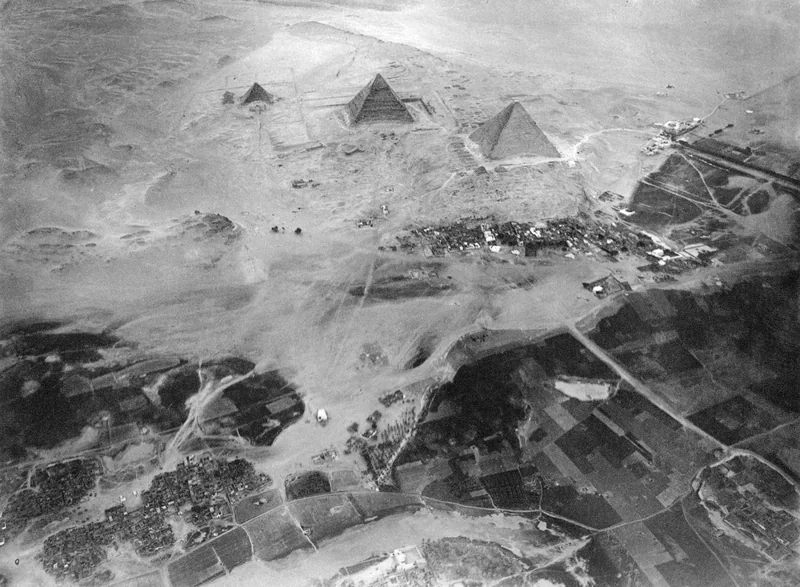
The question of how the pyramids were built, Britannica writes, has not received a wholly satisfactory answer.1 The most plausible account in that article is a sloping and encircling embankment of brick, earth and sand, with stone blocks hauled up by sledges, rollers and levers.1
Approximately 2.3 million blocks of stone were cut, transported and assembled to create the 5.75-million-ton structure.1 The sides of the Great Pyramid, Britannica says, rise at an angle of 51°52′ and are accurately oriented to the four cardinal points of the compass.1
According to Herodotus, as reported by Britannica, the Great Pyramid took 20 years to construct and demanded the labour of 100,000 men.1 By the late twentieth century, archaeologists had found evidence that a more limited workforce may have occupied the site permanently, perhaps as few as 20,000 workers plus support personnel.1
Excavations in the late 1980s and 1990s revealed labourers’ districts near the pyramids, including bakeries, storage areas, workshops, and the small tombs of workers and artisans.1
In 1984, Mark Lehner and David Goodman measured the elusive base of the Great Pyramid of Khufu.2 Stripped of nearly all of its casing, Dash writes, the monument no longer has any corners, nor well-defined edges.2
How many people built it?
Herodotus, as reported by Britannica, said 100,000 men and 20 years, a figure Britannica calls believable if the work was mainly seasonal. Late twentieth-century archaeology, in the same article, points to a more limited permanent workforce, perhaps as few as 20,000 plus bakers, physicians, priests and other support. Both accounts stay on the page.
Historians still debate what the pyramid form represents: a stairway for the pharaoh’s ka, the ancient mound of creation, or sunrays spreading to the earth.1
Those readings of the pyramid form — a stairway for the ka, the mound of creation, or sunrays — are kept in view. This site does not pick one.